
Concrete Retaining Walls for Florida Landscapes
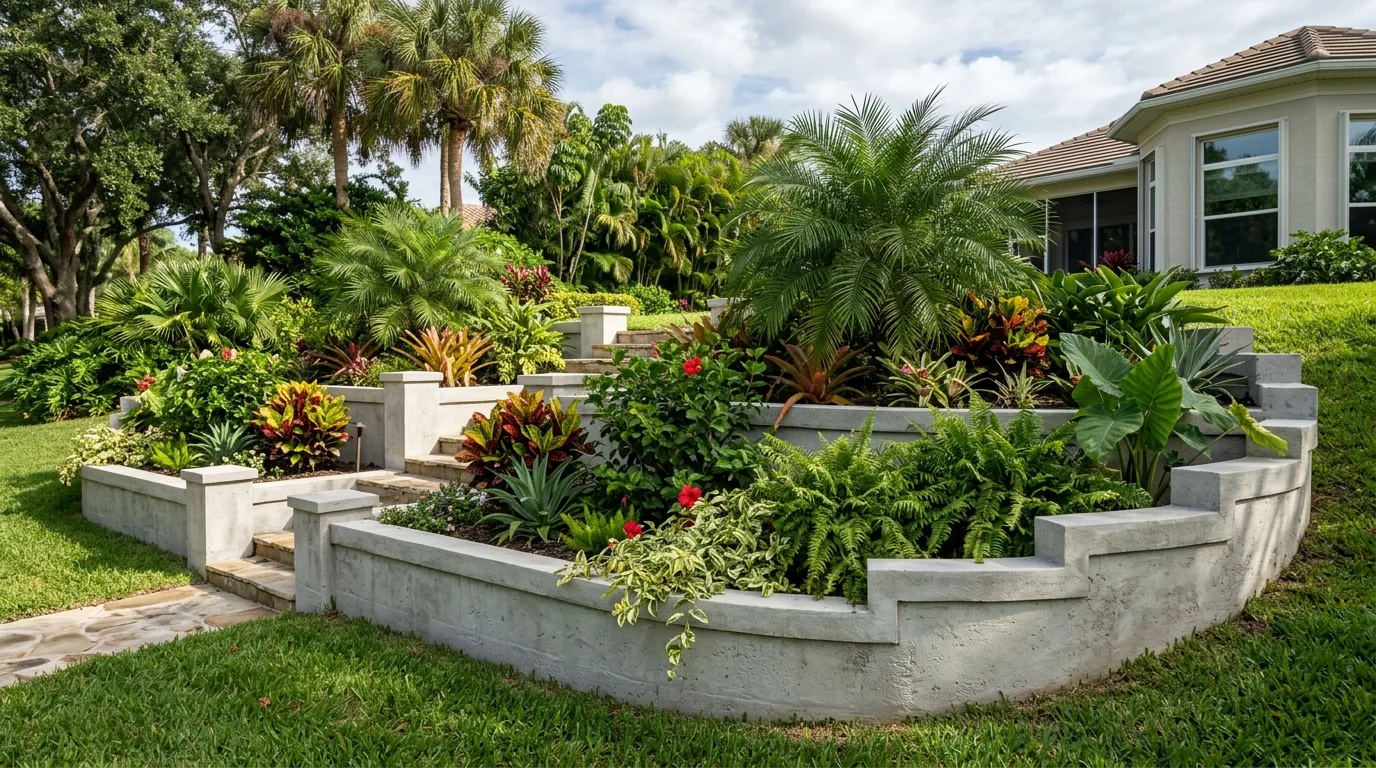
Florida may be famously flat, but even in University Park’s gently rolling terrain, retaining walls play a crucial role in landscape management, erosion control, and property aesthetics. When you need to hold back soil, manage slopes, or create usable level areas in your yard, concrete retaining walls offer unmatched durability and design flexibility.
Free Retaining Wall Estimate
University Park Concrete builds durable concrete retaining walls throughout the Sarasota-Bradenton area.
Why Concrete Retaining Walls Work Well in Florida
Florida’s environment presents specific challenges for retaining wall materials:
- Heavy rainfall: Florida receives 50–60 inches of rain annually. Retaining walls must manage significant water pressure without failure.
- Expansive soils: Manatee County’s clay soils expand and contract significantly, placing lateral forces on wall structures.
- High humidity: Materials that rot, rust, or degrade in humidity (untreated wood, some metals) fail quickly in Florida.
- Termites: Wood retaining structures are extremely vulnerable to Florida’s aggressive termite populations.
Concrete — whether poured-in-place, concrete block (CMU), or precast — handles all of these challenges effectively. It doesn’t rot, rust, or attract termites, and properly designed concrete retaining walls can manage the hydraulic and soil pressures Florida’s environment creates.
Types of Concrete Retaining Walls
Poured Concrete Retaining Walls
Poured-in-place concrete walls are the most monolithic and structurally sound option for taller walls (over 3 feet). They require formwork, rebar reinforcement, and proper drainage systems, but the result is an extremely durable, long-lasting wall.
Best for: Walls over 3 feet tall, structural applications, walls near buildings or structures
Cost: $25–$55 per sq ft of wall face
Concrete Block (CMU) Retaining Walls
Concrete masonry unit (CMU) walls use standard or specialty concrete blocks laid in courses with reinforcement and grout fill. They’re versatile, widely available, and can be finished with stucco or left with an exposed block face.
Best for: Medium-height walls (2–6 feet), situations where poured concrete is impractical
Cost: $20–$45 per sq ft of wall face
Segmental Retaining Wall Blocks
Precast concrete segmental wall blocks (like Versa-Lok or Allan Block) lock together without mortar to create gravity retaining walls. These are commonly used for landscape walls under 4 feet and are more of a DIY-friendly system.
Best for: Landscape walls under 4 feet, garden beds, terraced areas
Cost: $15–$35 per sq ft of wall face
Concrete Curbing as Low-Level Retaining
For smaller grade changes (under 12 inches), decorative concrete curbing can serve as a low-level retaining element while also providing landscape definition.
Need a Retaining Wall in University Park?
Get a free estimate for your concrete retaining wall project.
Critical Design Elements: Drainage
This is the most important section of this guide. More retaining walls fail from poor drainage than from structural weakness. In Florida’s heavy rainfall environment, drainage design is non-negotiable.
Weep Holes
At minimum, every concrete retaining wall needs weep holes — openings near the base of the wall to allow hydrostatic water pressure to escape. Walls without weep holes can fail catastrophically when water pressure builds behind them.
Drainage Aggregate and Fabric
Behind any retaining wall, a layer of coarse drainage aggregate (typically clean crushed stone) separated from the native soil by geotextile fabric allows water to migrate to the weep holes rather than building up pressure against the wall.
French Drains
For taller walls or high-water-table situations, a perforated pipe drain installed at the base of the aggregate layer can carry water away from the wall to a suitable discharge point.
Skipping or shortcutting drainage is the #1 mistake in retaining wall construction. Always ask your contractor specifically about their drainage design.
When Do You Need a Permit for a Retaining Wall in University Park?
In Manatee County, retaining walls generally require a building permit when:
- The wall is more than 48 inches high (measured from grade)
- The wall supports a surcharge (driveway, building load)
- The wall is within setbacks from property lines or easements
Always verify with Manatee County Building Department before beginning any retaining wall project. University Park Concrete handles permit applications as part of the project when required.
Cost of Concrete Retaining Walls in University Park
Retaining wall costs are typically priced per linear foot of wall (including height), or per square foot of wall face:
- Low landscape wall (under 2 ft, segmental blocks): $25–$40 per linear ft
- Medium wall (2–4 ft, CMU or segmental): $40–$80 per linear ft
- Tall structural wall (4–6 ft, poured concrete): $80–$150 per linear ft
- Complex walls with drainage and engineering: Premium pricing
For a quick estimate, try our cost calculator or contact us for a free on-site assessment.
Retaining Wall Design Ideas for University Park Properties
Concrete retaining walls don’t have to look industrial. Design options include:
- Stucco-finished CMU walls painted to match or complement your home
- Decorative block patterns — split-face, ribbed, or smooth finishes
- Tiered garden walls creating multiple level planting areas
- Walls with integrated planters or seating
- Colored concrete for poured walls to add visual warmth
- Combination walls using concrete as the structural backbone with stone or tile veneer
For inspiration on how retaining walls can integrate with your overall landscape design, read our concrete curbing guide and decorative concrete options.
Maintenance of Concrete Retaining Walls in Florida
Concrete retaining walls require minimal maintenance, but some care extends their life:
- Keep weep holes clear — check annually and clear any blockage
- Monitor for cracks — minor hairline cracks can be sealed; structural cracks need assessment
- Address drainage issues immediately — standing water behind a wall is a warning sign
- Seal painted or stucco surfaces every 5–7 years in Florida’s UV environment
- Control vegetation — large roots can infiltrate and damage walls over time
Related resources:
Build Your Concrete Retaining Wall in University Park
Professional retaining wall installation with proper drainage design. Serving University Park, Bradenton, Sarasota, and Manatee County.