
Concrete Foundation Issues in Florida: Warning Signs and Fixes
Foundation problems strike fear into homeowners — and rightfully so. A compromised foundation can threaten the structural integrity of your entire home and significantly impact its value. In University Park, FL, where Manatee County’s clay-rich soils are notorious for movement, foundation issues are unfortunately more common than in areas with more stable soil conditions.
This guide helps you recognize warning signs, understand causes, and explore repair options for concrete foundation issues in University Park and the greater Sarasota-Bradenton area.
Foundation Concern? Get a Free Assessment
University Park Concrete provides honest, no-pressure concrete foundation evaluations.
Understanding Florida’s Foundation Challenges
Expansive Soils
Manatee County and much of Southwest Florida sit on expansive clay soils that shrink and swell significantly with moisture changes. During our rainy season (June–September), soils absorb water and expand, pushing on foundations. During dry season, soils contract and pull away. This cyclical movement is a primary driver of concrete foundation cracking throughout University Park.
Florida’s Typical Foundation Types
Most University Park homes are built on one of these foundation types:
- Slab-on-grade: The most common — a concrete slab poured directly on compacted fill, typically 4–6 inches thick with reinforcement
- Stemwall with slab: Concrete stem walls sit on footings and support the slab above grade
- Shallow footings: Continuous or isolated concrete footings supporting structural loads
Understanding your foundation type helps evaluate problems correctly.
Warning Signs of Concrete Foundation Problems
Exterior Warning Signs
Cracks in the foundation wall or slab perimeter
- Vertical cracks: Often indicate differential settlement; may be serious
- Horizontal cracks: Most serious — indicate lateral soil pressure (foundation walls)
- Diagonal/stair-step cracks: Common with differential settlement, particularly in block or brick foundations
- Wide gaps (over 1/4 inch): Require immediate professional assessment
Cracks in exterior walls, especially at window and door corners Diagonal cracks radiating from the corners of windows and doors are a classic sign of foundation movement.
Doors or windows that stick or won’t close properly When a foundation shifts, it distorts the frame of the house. Suddenly difficult-to-operate doors and windows are a red flag.
Gaps between the wall and ceiling or floor Visible separation between walls and floors, or walls and ceilings, indicates differential movement.
Interior Warning Signs
Sloping or uneven floors Easy to detect by placing a marble on the floor — if it rolls consistently in one direction, the floor may not be level.
Cracks in interior walls or drywall Especially diagonal cracks near doorways and window corners.
Separation at baseboards or crown molding Gaps between trim and walls or floors indicate movement.
Sticking interior doors Similar to exterior doors, interior doors that suddenly stick or bind can indicate foundation issues.
Worried About Foundation Cracks?
Get a free, honest assessment from University Park Concrete. We'll tell you exactly what you're dealing with.
Common Causes of Concrete Foundation Damage in University Park
Settlement
Settlement occurs when soil beneath the foundation compresses unevenly, causing parts of the foundation to drop lower than others. In University Park, settlement is often triggered by:
- Improperly compacted fill placed before construction
- Organic material (old tree stumps, vegetation) decomposing beneath the slab
- Erosion of soil under the foundation from water infiltration
- Changes in the water table
Expansive Soil Movement
As described above, Florida’s clay soils move with moisture changes. Proper drainage design and maintaining consistent soil moisture around your foundation’s perimeter helps minimize this movement.
Tree Root Intrusion
Large trees too close to a foundation can cause problems in two ways: roots directly lifting or pushing foundation elements, and root systems extracting moisture from soil around the foundation, causing shrinkage and settlement.
Plumbing Leaks Under Slab
A slow leak from under-slab plumbing can erode the soil below the slab, leading to voids and eventual settlement. This is a hidden but significant problem in older University Park homes.
Poor Original Construction
Inadequate base preparation, insufficient reinforcement, or improper concrete mix at the time of construction can lead to long-term foundation performance problems.
Foundation Repair Methods
Concrete Crack Injection
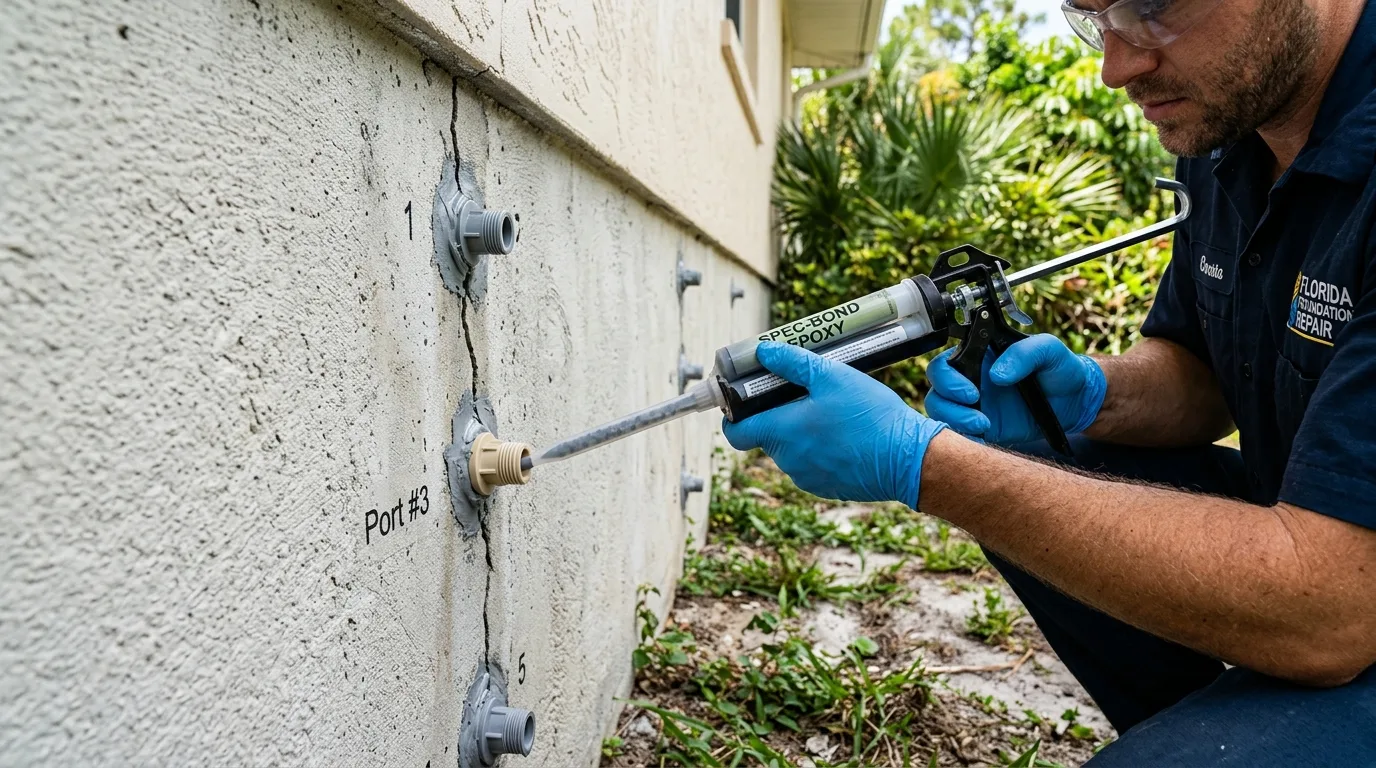
For non-structural cracks that allow water infiltration, epoxy injection or polyurethane foam injection can effectively seal the crack and restore water resistance. This is not appropriate for structural cracks where movement is ongoing.
Slabjacking (Mudjacking)
Mudjacking or slabjacking involves drilling holes in the settled slab and pumping a grout mixture (or polyurethane foam in newer systems) underneath to fill voids and lift the slab back to level. This works well for settled but intact slabs.
Underpinning (Piering)
For significant settlement, steel piers are driven or drilled down through unstable soil to reach bearing stratum below. The structure is then hydraulically lifted back toward level. This is a more invasive but highly effective long-term solution.
Full Slab Replacement
When a foundation slab is too damaged for cost-effective repair, full or partial replacement is the right answer. New construction practices (better fill, proper reinforcement, moisture barriers) ensure the new slab performs better than the original.
When to Call a Structural Engineer
Not all foundation cracks require structural repair — many are cosmetic or involve minor moisture issues. But call a licensed structural engineer if you observe:
- Cracks wider than 1/4 inch
- Horizontal cracks in foundation walls
- Significant floor slope (more than 1 inch per 8 feet)
- Multiple warning signs occurring together
- Rapid progression of existing cracks
University Park Concrete can assess concrete-related foundation issues, but for comprehensive structural evaluation, a licensed structural engineer provides the professional opinion needed for insurance claims and real estate transactions.
Cost of Concrete Foundation Repair in University Park
- Crack sealing/injection: $500–$2,500 depending on length and number of cracks
- Slabjacking (per location): $1,000–$4,000
- Underpinning piers: $1,500–$4,500 per pier (most projects require 4–12 piers)
- Partial slab replacement: $2,000–$10,000+ depending on area
- Full slab replacement: Varies widely by home size
Related Resources
- How to Fix Concrete Cracks in University Park
- How Long Does Concrete Last in Florida?
- How to Maintain Concrete in Florida’s Climate
For foundation concerns in Bradenton, Sarasota, or surrounding areas, we offer free assessments throughout the region.
Professional Foundation Assessment in University Park
Don't ignore foundation warning signs. Call University Park Concrete for an honest evaluation today.