
How to Fix Concrete Cracks in University Park FL
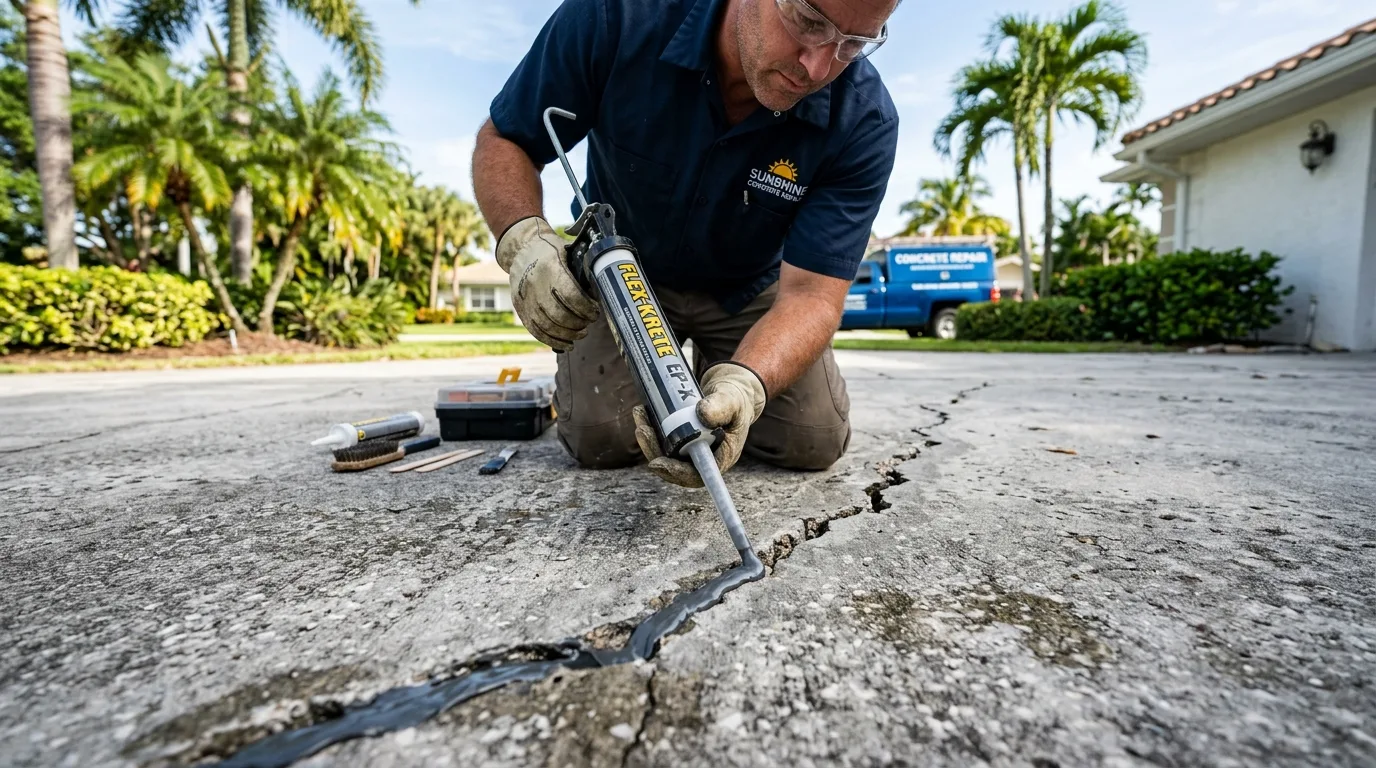
Concrete cracks are one of the most common homeowner headaches in University Park, FL. Whether it’s your driveway, patio, sidewalk, or garage floor, seeing those hairline fractures or gaping cracks can be alarming. The good news? Not all cracks are created equal, and many can be effectively repaired without replacing the entire slab.
Get a Free Concrete Crack Assessment
University Park Concrete provides free, honest evaluations of your concrete damage — no sales pressure.
Why Does Concrete Crack in University Park, Florida?
Understanding why concrete cracks helps you assess severity and prevent future damage.
Florida’s Expansive Soils
Manatee County has significant clay content in its soils. Clay expands when wet and contracts when dry — causing the concrete above to move, flex, and eventually crack. This is one of the primary causes of driveway and patio cracking in University Park.
Thermal Expansion and Contraction
Even in Florida’s relatively mild temperature range, concrete expands in summer heat and contracts in cooler months. Over time, this cyclic movement creates stress fractures, especially if control joints weren’t properly placed during installation.
Tree Roots
Florida’s lush vegetation is beautiful — but tree roots are a top cause of concrete upheaval and cracking. As roots grow, they can lift slabs, create dramatic cracks, and even displace entire sections of a driveway or sidewalk.
Improper Curing
Concrete that dried too quickly during installation (a risk in Florida’s summer heat) develops surface checking and shrinkage cracks. These are usually cosmetic but can allow water intrusion.
Heavy Loads
Standard residential concrete is designed for vehicles up to about 4,000 lbs. Delivery trucks, RVs, or heavy equipment parked on a residential driveway can cause premature cracking.
Types of Concrete Cracks and What They Mean
Hairline Cracks (Surface Cracks)
Width: Less than 1/16 inch Severity: Usually cosmetic Action needed: Monitor and seal to prevent water intrusion
Hairline cracks are extremely common in Florida concrete and usually result from normal shrinkage during curing. They don’t indicate structural problems and can be sealed with a concrete crack filler or penetrating sealer.
Narrow Cracks (1/16 to 1/4 inch)
Width: 1/16 – 1/4 inch Severity: Low to moderate Action needed: Fill with polyurethane or epoxy crack filler
These cracks should be repaired to prevent water infiltration. Water in cracks accelerates damage through erosion of the base material and freeze-thaw cycling (even in Florida, we get occasional cold snaps).
Wide Cracks (Over 1/4 inch)
Width: 1/4 inch and larger Severity: Moderate to serious Action needed: Professional assessment and repair
Wide cracks can indicate base settlement or soil movement underneath the slab. They need proper evaluation to determine if a simple fill will suffice or if the slab needs to be raised, stabilized, or replaced.
Displacement Cracks (Heaved or Sunken)
Characteristics: One edge of the crack is higher or lower than the other Severity: Serious Action needed: Professional repair — mudjacking or slab replacement
When the two sides of a crack are at different elevations, it means the ground beneath has shifted. This requires more than a simple fill — the underlying cause must be addressed.
Worried About Your Concrete Cracks?
Call University Park Concrete for a free, no-pressure assessment. We'll tell you exactly what needs fixing.
DIY Concrete Crack Repair: What Homeowners Can Do
For minor cracks (less than 1/4 inch) with no displacement, many homeowners can make effective repairs.
What You’ll Need
- Concrete crack filler (polyurethane sealant or self-leveling crack filler)
- Wire brush or angle grinder with masonry wheel
- Shop vacuum
- Masking tape
- Concrete sealer
Step-by-Step Process
- Clean the crack thoroughly — Use a wire brush, broom, or pressure washer to remove dirt, debris, and loose material from the crack
- Widen narrow cracks — For hairline cracks, use an angle grinder to widen to 1/4 inch for better adhesion
- Vacuum the crack — Remove all dust and loose particles
- Apply backer rod (for cracks deeper than 1/2 inch) — Fill deep cracks with foam backer rod before applying sealant
- Apply crack filler — Use a polyurethane or epoxy crack filler according to product directions
- Smooth and feather the surface — Tool the sealant flush with the concrete surface
- Allow full cure time — Follow product instructions (typically 24–48 hours)
- Seal the entire surface — Apply concrete sealer to protect the repair and surrounding area
When to Call a Professional Concrete Contractor
DIY repairs are appropriate for minor cracks, but call a professional when:
- Cracks are wider than 1/2 inch
- There is displacement (one side higher or lower)
- Multiple cracks form a pattern suggesting base failure
- Concrete is crumbling, not just cracking
- Cracks reappear after previous repairs
- Foundation-adjacent cracks need evaluation
These signs may indicate deeper problems with the base, subgrade, or structure that require professional diagnosis and repair. Learn more about concrete foundation repair in our dedicated guide.
Professional Concrete Repair Methods
Epoxy Injection
For structural cracks in load-bearing concrete, contractors inject low-viscosity epoxy into the crack to essentially weld the concrete back together. This is a specialized repair for structural elements.
Concrete Resurfacing
For surfaces with widespread surface damage, a concrete overlay or resurfacing product can be applied over the existing slab. This costs $3–8 per sq ft and gives aged concrete a fresh, new appearance.
Slab Replacement
When damage is too extensive to repair, partial or full slab replacement is the right answer. While more expensive upfront, replacement with proper base preparation and reinforcement gives you decades of trouble-free concrete.
Concrete Repair Costs in University Park
- DIY crack filler: $15–$50 in materials
- Professional hairline crack sealing: $200–$500
- Professional crack injection: $500–$1,500 depending on extent
- Concrete resurfacing: $3–$8 per sq ft
- Partial slab replacement: $1,000–$5,000+
Use our cost calculator for a quick estimate, or contact us for an accurate quote.
Preventing Future Cracks
The best repair is prevention. For University Park homeowners:
- Seal your concrete every 2–4 years (see our concrete maintenance guide)
- Keep trees away from concrete slabs — maintain at least 10 feet between concrete and trees
- Ensure proper drainage so water doesn’t pool under or around concrete
- Avoid heavy loads on residential driveways
- Redirect sprinkler heads away from concrete to minimize wet/dry cycling
Professional Concrete Repair in University Park, FL
Don't let small cracks become big problems. Call us for a free assessment today.